

Sameer Farooq
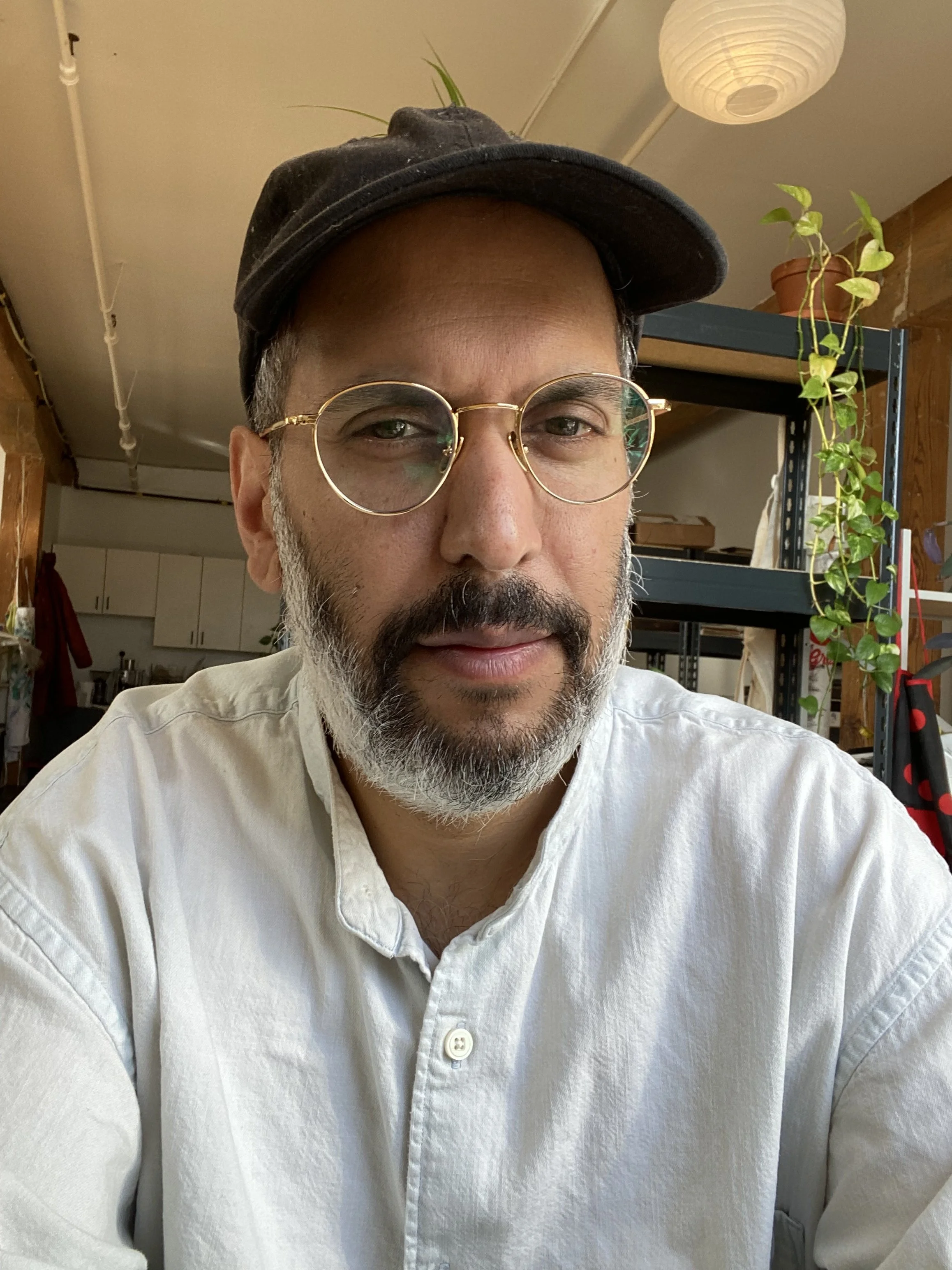
INTERVIEW WITH SAMEER FAROOQ
By Joana P. R. Neves
Empathy for the Institution
Our April 2026 resident was Sameer Farooq.
“While in London I will be researching the collections of several encyclopaedic museums and thinking about how we can re-choreograph their objects to broaden our understanding of history. This will involve trying to unfreeze “museum time.” The goal of my work is to always soften the edges of strict institutional categories and introduce surprising collisions and collaborations between different populations and regions.”
Sameer Farooq is a Toronto-based artist of Pakistani and Ugandan Indian descent. With a versatile approach that shifts between photography, documentary film, sculpture, and anthropological methods, he investigates strategies of representation to expand the ways through which museums have looked at the past through traditional forms of collection, interpretation and display. Farooq foregrounds community-based models of knowledge production and an array of contemplative practices in order to suggest new ways of narrating our cultural histories. The result is often a collaborative work which counterbalances how dominant institutions speak about our lives: a counter-archive, new additions to a museum collection, or a buried history made visible.
This residency marks the beginning of an annual Toronto-focused residency in partnership with Canada<->International and Toronto Biennial of Art (TBA). TBA residency artists will be selected from their past and present editions, deepening their engagement both locally and internationally.
A special thank you to Zoë Foster & Alexandra Lambert for this collaboration.
Personifying the museum might be one of the strangest forms of “institutional critique” I’ve come across recently. Worlding’s April resident, Sameer Farooq, has imagined what would happen if the museum saw a therapist, in collaboration with the Dutch artist Marjam Linschooten. Their video The Museum Visits a Therapist, 2021, is the outcome of a four-year engagement with Amsterdam’s Tropenmuseum, and will be on display during the artist’s Open Studio on the 28th of April 2026. Save the date!
It’s fair to wonder whether Sameer Farooq’s approach to the art institution is as acerbic as Hans Haacke’s, or, later, Andrea Fraser’s. As a second generation immigrant in Canada – his mother is of Ugandan descent, and his father was born in Pakistan – he would be well placed to do so, but the word “empathy” does come up during our conversation regarding the inheritance of the massive, and problematic collections amassed over years of colonial rule. Perhaps because before embracing an artistic career, Farooq studied cultural anthropology at McGill University in Montreal, his focus on archival systems – now as an artist – is equipped with an awareness of the complex scientific and subjective stories behind archives.
Sameer Farooq, If it were possible to collect all navels of the world on the steps to ASCENSION, 2019. Installation view at Dalhousie Art Gallery, 2023. Photo: Steve Farmer.
Can an Object Hide its History?
Fascinated by objects, by what they carry and how they might catalyse life, Farooq seems closer to the constellation of artists for whom the museum is a source of concerned fascination: inherently imperial, governed by the current versions of old empires, managed by wealth, it is also visited and curated by people who genuinely care about what is there. The question might then be: aren’t we missing out on a clear-eyed view of the museum as a tool for dialogue about the difficult histories it encloses? The artefacts exhibited represent cultures and have specific roles in them. But the reason why they were taken, and the local cultural entanglements they represent are often obliterated by a grandiloquent language focusing on possession, luxury and exception, taking over global discourse, and uncritically touching upon notions of nationality and identity.
Do artists have a role to play there? Sameer Farooq took the matter into his own hands by looking at what sustains the object rather than the object itself: the bureaucratic limbo, the compulsive scenography, the unquestioned typologies, through productions whose artistic language is chosen for each situation, such as ceramics, photography, video, museum displays, and more. But first, I wanted to find out more about his life growing up in Canada and the root of his affinity with object displays.
Follow Sameer Farooq on Instagram
The Chest in the Basement
Joana P. R. Neves: I’m curious about your life growing up in Cape Breton, and your relation to objects. Were you always fascinated by them?
Sameer Farooq: Some of my earliest memories are of, as a young child, sitting on the floor and rifling through objects, ordering them, trying to understand where each one came from, and their meaning. In our basement, we had a chest with what my parents could take when they left Pakistan and Uganda. My father is from a small village in Punjab, Pakistan, and my mom is from Uganda, in East Africa. They met in the UK. My mom and her family were expelled during Idi Amin’s rule in the early 70s; my father was a medical resident in the UK. In the 60s, there wasn’t a lot of upward career movement because of racism: he describes having colleagues at the same level being promoted for jobs in the hospital, while the South Asian ones remained in lower positions. So, on a romantic walk, my parents passed by the Canadian embassy and said: “let’s go in and see if we can move to Canada”. Canada being desperate for professionals, the woman signed the paper immediately They were welcoming professionals in rural, outlying areas, so my parents ended up in Eastern Canada on the small Cape Breton Island, off the coast of Nova Scotia. But they fell in love with it and its community. I think it reminded them of the UK, as a very Scottish and Irish area. My brother and I were born and brought up there.
Back to the chest in the dusty basement: I remember going alone and opening it. There was a large snake skin that my mom had kept from Africa, there were etched, tin vases that my dad brought from Pakistan, some photographs… I tried to make sense of the past and of where we were: a floor above, there were mass produced objects from Canada and the United States, plush carpeting, artificial flowers, ceramic animals – it was the 1980s! That’s when the obsession arose.
J.P.R.N.: You said you ordered them? What did you do with those objects?
S.F.: I would lay them out, I would play with them. It’s an interesting question: what makes a museum? Could that be a museum? When we think about the earliest museum, Ennigaldi-Nanna’s…
J.P.R.N.: Yes! The first ever curator that we know of, was indeed a woman, Ennigaldi. Her museum was built around 500 BCE and was located in current Iraq. Objects were found and she thought: ”we have to organize, study and show them to people”. There was a motivation of keeping and showing and ordering and making sense. I guess you had the same instinct as a child!
S.F.: I think about what this psychological pull to spatially organize objects in a room is about. I studied anthropology in university. Then, I worked at the Canadian embassy, in the foreign service, in Beijing. My job was, mainly, helping Canadians in emergency situations: making passports, shipping back bodies of deceased Canadians, trying to uncover business scams by Canadians in China... It was a really weird job. But having that anthropology lens gave me a critical outlook on wherever I lived. I ended up going back to China a number of times as a documentary filmmaker. After, I went to art school in Amsterdam, where this combination of anthropology studies and art came together. Now I feel a proximity to the visual anthropologists, but my work is a little freer, less scientific and more associative, performative, instinctual.
Sameer Farooq, Installation view, A Heap of Random Sweepings. 2021, The Koffler Centre of the Arts, Toronto, ON, Canada, Curated by: Mona Filip; Installation Poetry: Jared Stanley; Sound Composition: Gabie Strong. Photo: Toni Hafkenscheid.
Imperfect Archives
J.P.R.N.: Are there any anthropologists that left a mark–or the opposite?
S.F.: Ann Laura Stoler, who is a New York based anthropologist. She wrote a book called “Along the Archival Grain” 1 ; it has affected a lot of my work. It looked into Dutch colonialism, especially in Indonesia. She came across ledgers and records kept during their violent colonial rule. She noticed that, rather than being a brute, organized, relentless force,it was made up of young soldiers who had no idea where they’d landed. So, in the marginalia of the documents there were mistakes, things crossed out, a lot of anxiety in documenting. When I work with institutions, I’m interested in them as places that are invented and falling apart, continually. And by, like Ann Laura Stoler, not assuming that the perpetrators were all powerful, but naive, questionable, inadequate, non-experts. It breathes a lot of empathy in the institutional critique model. She has been a huge influence. And I continue to love anthropology – it has a dubious history, but it is a self-critical discipline. What I loved about studying it, was its willingness to admit mistakes and keep reinventing itself. When I meet contemporary anthropologists, I ask them what they’re reading, what they’re thinking about now, how the models changed.
1 - Ann Laura Stoller, Along the Archival Grain, Epistemic Anxieties and Colonial Common Sense, 2009, Princeton University Press.
READ THE REST OF THE INTERVIEW ON OUR SUBSTACK PAGE, FOLLOW US, OR SIGN UP.